
Blog
What is in a therapist’s heart

Tips to Help You Focus
A common frustration in the busy world we live in is difficulty concentrating. Many mental illnesses are associated with difficulty concentrating. Concentration problems are associated with depression, attention-deficit hyperactivity disorder (ADHD), bipolar disorder, anxiety disorders, and psychotic disorders like schizophrenia. Regardless of what is causing you concentration difficulties, there are ways in which you can help your brain focus. Here are 3 tips:
1.Chunking. Chunking is a technique used to facilitate retention. It’s why phone numbers are separated into sets of 3’s and/or 4’s. Use this principle to increase concentration. Create to-do lists and then separate your duties into chunks. Tackle one at a time. Then, take a short break to reset your brain.
2. Know yourself. How do you concentrate best? Do you concentrate best with music or in silence? Knowing yourself helps you set yourself up for concentration success
3. Objectify. Having something physical to touch, like a small rock or other trinket, can increase concentrate ability. Being able to rhythmically control an object creates positive changes in the brain that actually improve concentration.
Why Can Mental Illness Be So Hard to Diagnose?
Sometimes the process of diagnosing mental illness can be frustrating. Frequently, someone experiencing a mental health crisis is well aware that something is wrong. Naturally, he or she wants answers. It can take months, and sometimes years, for doctors and other mental health professionals such as myself to accurately diagnose a mental illness. Some reasons for this can be:
- The signs and symptoms of mental illnesses often lap. For example, psychotic features are a part of schizophrenia and other psychotic disorders as well as mood disorders, dissociative disorders, and personality disorders. There are distinct criteria and symptoms of every mental disorder. However since each person is unique what is depression for one person may not be depression for another.
- Generally speaking there are no medical tests to diagnose mental illness.
Thus instead of seeking an accurate diagnosis, albeit this is important, I often look at how the person operates and reacts to their environment. The dynamics in the Individual’s psychological and social world often provides key areas to assist the person to cope better with their lives and hence find healing.
Sleep better
Lately I am finding that a lot of people are struggling to sleep well. Individuals with mental illness seem to in particular have difficulty sleeping well. Screen time before sleep time is a problem. Many people are looking at screens (televisions, smartphones,i-pads,tablets) before bedtime. Screens disrupt your ability to fall asleep and your quality of sleep. The blue light emitted by these devices decreases the amount of melatonin released ( which peaks at bedtime) and will affect your quality of sleep (your deep REM sleep). Thus I am suggesting that you stop using your devices 1 hour before bedtime. If you need to have your cell phone in your bedroom keep it and charge it far away from where you sleep to decrease the temptation to use it.
Coping with ADHD
ADHD stands for Attention Deficit hyperactivity disorder. ADHD makes it difficult for a person (most often children but not exclusively) to pay attention and stay focused. A child with ADHD can be more impulsive, which can lead to issues with learning and maintain friendships. Furthermore, difficulties with organisation, listening to instructions, remembering details and controlling behaviour may be experienced.
Here are a few suggestions on how to help a person with ADHD cope better:
- Make a schedule
- Make simple house rules
- Make sure your directions are understood
- Reward good behaviour in children
- Supervise a child, when possible
- Set a homework routine
- Focus on a child’s effort instead of grades
- Communicate openly and often with the child’s teachers.
Getting out of bed with Depression Checklist
Keep the checklist by your bed and use it every day to make getting up and staying up a habit.
- Get your blood flowing. Stretch arms, legs, and torso. Roll your wrists, ankles, and neck.
- Breathe slowly, deeply.
- Continue to stretch and breathe while you drink the glass of water you placed beside your bed.
- In the notebook beside your bed, write one reason you have for getting up. Repeat it out loud.
- Write something you are grateful in your notebook
- Stand up and make your bed immediately.
- Reward yourself with tea or coffee or something else you enjoy.
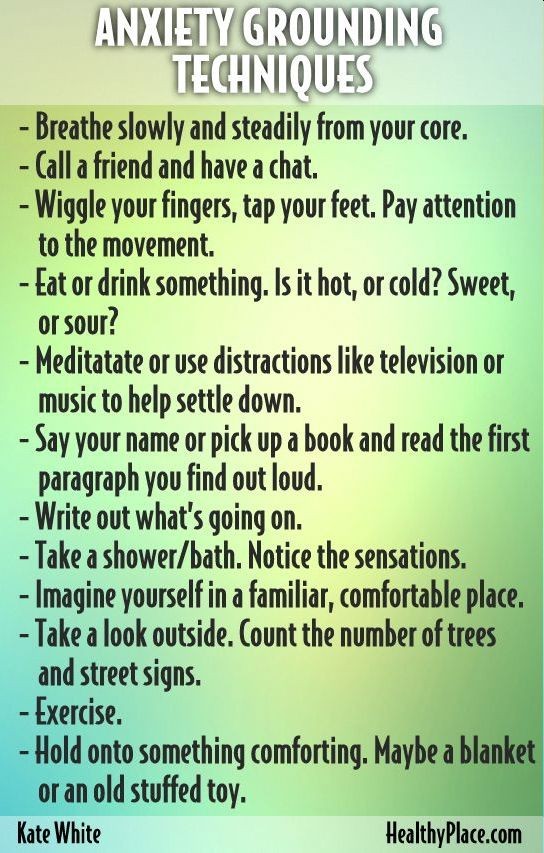
Anxiety grounding techniques

One day at a time

Marijuana and Schizophrenia are Linked
Research has shown connections between marijuana, the brain, and schizophrenia:
- Cannabis interferes with executive functioning, which includes such skills as memory, emotional regulation, planning, problem-solving, inhibition, organization, starting tasks, and processing information.
- It interacts with the dopamine system in the brain, impacting the experiencing of psychosis.
- Smoking marijuana daily has been shown to increase a vulnerable user’s risk of developing schizophrenia by almost five times, and it can cause people to develop schizophrenia six years earlier than others who don’t use the substance.
- Using marijuana can worsen schizophrenia in those who already have the illness.
Workplace Mental Health: How to Protect Yours
Unhealthy work environments can involve toxic supervisors, workplace bullying, inflexible policies, lack of control and freedom, or negative co-workers.
Workplace mental health challenges that can arise as a result include and not exclusive to:
- Heightened stress
- Burnout
- Depression
- Anxiety
- Declining self-confidence
- Substance use
- Sleep problems
It’s possible to take control of your own mental health at work and make your job more positive. Try these tips:
- Identify what is right and what is wrong. Increase what is right. Address what is wrong.
- Respect yourself; you don’t need approval from people you dislike.
- Connect with positive people.
- Calm your mind and body with deep breathing and mindfulness.
- Make your own space a happy place.
- Practice stress management